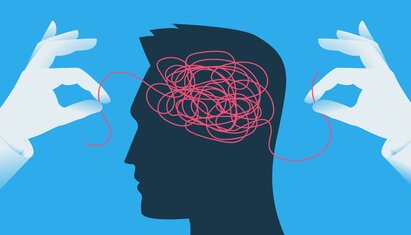
What is Internal Family Systems (IFS) therapy?



Published November 9, 2026

You may have heard the idea that the amount of “suffering” we feel is equal to how large the gap is between how things are and how we want things to be. This concept goes back thousands of years and is rooted in Buddhist and Eastern teachings, and you may have come across this or a similar quote in various mindfulness-oriented workshops.
However, did you know that the earliest form of cognitive-behavioral therapy (CBT), known as Rational Emotive Behavior Therapy (REBT), was developed to address this suffering gap directly?
Albert Ellis, developer of REBT and pioneer of early CBT, helped pave the way for therapists to support their clients in identifying and disputing irrational beliefs that contributed to suffering and rigidity in behavior.
Ellis first introduced REBT in 1957 under the name rational therapy, and it became rational emotive behavior therapy in the 1990s. The ABC model is its foundation, and the ABCs of cognitive-behavioral therapy remains one of the most influential frameworks in the field. Many CBT clinicians use similar frameworks that link a situation, a thought, and an emotional reaction, even when they don’t call it the ABC model.
As you’ll see throughout this blog, many of these distorted beliefs include internalized rules held about how life “should” or “must” be, which can cause immense suffering.
The ABCs of cognitive-behavioral therapy provide a framework for understanding how a client’s core beliefs affect their feelings and behaviors.
“A” stands for activating event, which is the situation, memory, or experience that sets the sequence in motion.
“B” stands for the specific beliefs clients have about that event.
“C” stands for the emotional or behavioral consequences of attaching to those beliefs. The key point is that the belief at B, not the event at A, drives the consequence at C.
Clinicians often capture all three in an ABC worksheet with the activating event, belief, and consequence, which we'll cover below.
The ABCs of cognitive-behavioral therapy break down irrational beliefs into four primary categories. In my own clinical work, knowing these four categories has been instrumental in applying the ABCs of cognitive-behavioral therapy, allowing me to guide clients in identifying and noticing distortions in their thinking.
The four beliefs are demandingness, awfulizing (also called catastrophizing), low frustration tolerance, and global evaluations. In a study of 99 students, all four were directly related to distress, and the effect of demandingness appeared to work through the other three. In other words, demandingness is the core belief, and the others tend to grow out of it.
Demandingness is when people hold rigid thoughts that life and the universe as they know it must operate in a very specific way. This often comes in the form of thoughts of "shoulds" or "musts."
Another way to think about demandingness is when individuals demand that life needs to match their expectations of how life actually is, even when that is illogical and unhelpful.
Here is how demandingness might sound in clients dealing with anxiety, depression, or anger:
Anxiety: “I must not feel anxious.”
Depression: “I need to be motivated before going out.”
Anger: “People should respect me.”
Awfulizing or catastrophizing is when people interpret an already unpleasant or uncomfortable trigger as though it’s bad in the absolute or “the end of the world.” The language is usually extreme.
Awfulizing often shows up in session in statements like these:
Anxiety: “I need to get this mole checked. If it’s cancer, my life is over. It would be the worst thing imaginable.”
Depression: “I’ve been so lonely and isolated. This is a living hell. I can’t imagine anything worse.”
Anger: “Can you believe she honked at me? How dare she? What an awful thing to do.”
Low frustration tolerance is the distorted belief that people can't handle discomfort, anxiety, awkwardness, or other unpleasant feelings.
Clients with anxiety, depression, or anger might express low frustration tolerance this way:
Anxiety: “I want to go to the party, but I don’t think I’ll be able to handle the anxiety.”
Depression: “The heaviness in my shoulders is too much. I can’t tolerate going out.”
Anger: “I’m scared that if he gives me a dirty look, I’ll feel so angry that I’ll totally lose control. I don’t think I can handle how bad I’ll feel.”
Finally, global evaluation happens when people judge the entire worthiness of themselves, others, or life based on very singular, specific, and/or independent aspects of a situation or event.
Global evaluations tend to sound like this across anxiety, depression, and anger:
Anxiety: “I can’t believe I said that to him. I’m such an awkward person.”
Depression: “There’s no point. The world is a bad place, and nobody cares about me.”
Anger: “Can you believe he talked about me behind my back? Everybody is just out for themselves.”
Helping clients gain insight into the beliefs that drive their suffering and dysfunction often starts with introducing the idea of the ABC worksheet with the activating event, belief, and consequence.
This allows individuals to practice the ABCs of cognitive-behavioral therapy in real time, giving them both heightened awareness and a helpful, detached perspective on how this plays out. It also provides a simple between-session homework assignment that you can have clients do from the beginning of therapy.
Download a free ABC worksheet with the activating event, belief, and consequence.
As with all forms of CBT, the ABC model of cognitive-behavioral therapy posits that insight alone into the relationship between triggers, thoughts, beliefs, and consequences won't necessarily lead to change or reduce suffering. Clients must learn how to effectively work with those beliefs in order to achieve the positive change that they want. Completing an ABC worksheet with the activating event, belief, and consequence reveals the pattern, but disputing the belief is what shifts it.
Ellis introduced two new letters to the ABC model of cognitive-behavioral therapy to help with this: D for disputing irrational beliefs, and E for “effective new philosophy” (or “effective new belief”), which is a belief that is more accurate and will better serve the client.
While you can use a variety of cognitive (e.g., reframing, cognitive restructuring, Socratic questioning), and behavioral (e.g., behavioral experiments, behavioral activation, exposure therapy) tools to help people get to the Ds and the Es, Albert Ellis specifically posited three ways of disputing irrational beliefs:
Empirically: Looking for how evidence matches up with their experience.
Logically: Helping people understand that just because they prefer something doesn't mean that, logically, the consequence has to happen.
Pragmatically: Helping people determine whether the belief is serving them effectively or not.
These and other forms of disputing irrational beliefs help pave the way for new, effective beliefs that reduce suffering and allow the person to behave in ways more aligned with their values.
If you’ve already had clients complete an ABC worksheet with the activating event, belief, and consequence, you can easily add a column for “D” and “E” at the end to capture the full Ellis REBT ABCDE model.
When working with the “D” and “E”, you want to help clients shift from inflexible, rigid beliefs to adaptive and logical beliefs. For example, you may help a client with social anxiety to shift from “I must be liked by everybody” to “it's okay to not be liked by everybody all the time, and it’s not the end of the world if somebody doesn’t respect me” or a client with borderline personality disorder to shift from “I can’t handle these feelings, it’s too much” to “these feelings are uncomfortable, but they won’t kill me, and there is enough space inside me for whatever my nervous system evokes.”
Albert Ellis Institute. (n.d.). Rational Emotive Behavior Therapy.
David, D., Cotet, C., Matu, S., Mogoase, C., & Stefan, S. (2018). 50 years of rational-emotive and cognitive-behavioral therapy: A systematic review and meta-analysis. Journal of Clinical Psychology.
DiLorenzo, T. A., David, D., & Montgomery, G. H. (2007). The interrelations between irrational cognitive processes and distress in stressful academic settings. Personality and Individual Differences.
Tiba, A. I. (2024). The grounded cognition foundation of the first cognitive model in cognitive behavior therapy: Implications for practice. Frontiers in Psychology.
SimplePractice is HIPAA-compliant practice management software with everything you need to run your practice built into the platform—from booking and scheduling to insurance and client billing.
If you’ve been considering switching to an EHR system, SimplePractice empowers you to run a fully paperless practice—so you get more time for the things that matter most to you.
Try SimplePractice free for 30 days. No credit card required.
Max Maisel, PhD, is a clinical psychologist with over 10 years of experience working with children, teens, and adults with OCD and anxiety disorders using Acceptance and Commitment Therapy (ACT) and Exposure and Response Prevention (ERP). He is the founder and CEO of Beachfront Anxiety Specialists, a boutique group practice in Los Angeles. He is a long-time member of the International OCD Foundation (IOCDF) and is the president-elect for the Southern California Chapter of the Association for Contextual Behavior Science (ACBS). Max has also provided workshops to thousands of clinicians and trainees and has been featured as a guest on several podcasts, discussing a range of OCD and anxiety-related topics. To find out more about Max, you can visit his website at Beachfrontanxiety.com or follow him on social media @DrMaxOCD.






Proudly made in Santa Monica, CA © 2026 SimplePractice, LLC
Proudly made in Santa Monica, CA © 2026
SimplePractice, LLC