Gender identity therapy worksheets


Published August 26, 2026
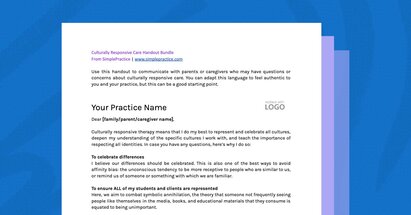
Download the LGBTQ+ terms handout
Download now
Download the LGBTQ+ terms handout
Download nowUsing accurate, affirming language matters in the therapy room. This LGBTQ+ glossary walks through the LGBTQ+ terms clinicians most often need—from sexual orientation to gender identity—so you can support clients with confidence.
We’ve included a free downloadable LGBTQ+ glossary handout that you can save to your electronic health record (EHR) and use in your practice.
The LGBTQ acronym and terms used to describe members of diverse sexual orientation and gender identities have evolved considerably over time. The first use of the term dates back to at least the 1700s, when the word lesbian was used. However, the existence of same-sex attraction between women dates back to ancient Greece and the poet Sappho, who wrote about her love for women. The term “lesbian” is derived from the Greek island, Lesbos, where Sappho spent most of her time.
In the 1950s, the American Psychiatric Association, in its first publication of the Diagnostic and Statistical Manual of Mental Disorders, used the word “homosexuality” to pathologize same-sex orientation as a “sociopathic personality disturbance.” However, decades of activism by gay rights activists, psychiatrists, psychologists, and leaders in the mental health community have changed those views, and today, more than 70 years later, all evidence of pathologizing same-sex love has been removed.
As part of that activism, LGBTQ+ people have reclaimed words like “gay” and “queer” which were once slurs, and from the mid-to-late 1980s, an acronym emerged that grouped sexually diverse identities, introducing the term LGB to describe lesbian, gay, and bisexual people.
Since the 1990s, the acronym has been expanded numerous times to incorporate the vastness of sexuality and gender, which include:
LGBTQ: Lesbian, gay, bisexual, transgender, and queer individuals. The letter Q can also mean questioning.
LGBTQ+: The addition of the plus sign means the inclusion of anyone who doesn’t fall under the other categories.
LGBTQQIA: Now includes questioning, intersex, asexual.
LGBTQIAAP: Includes pansexual, asexual, and allies.
LGBTQQIP2SAA: Includes Two-Spirit.
Use the following LGBTQ+ glossary of terms to provide care to clients:
Asexual: Called “ace” for short, asexuality refers to a spectrum of sexual attraction, from little or no interest to some interest in sexual activity with others.
Aromantic: A person who does not experience romantic attraction.
Ally: A person who actively supports and advocates for LGBTQ+ people, including straight and cisgender allies as well as LGBTQ+ people supporting other parts of the community.
Bisexual or bi: Attraction to more than one gender, not necessarily at the same time or to the same degree.
Bicurious: Describes a person who is curious about being attracted to more than one gender.
Gay: A person attracted to people of the same sex.
Intersex: A person with one or more innate sex characteristics, which could include reproductive organs, chromosomes, and genitals.
Lesbian: A woman attracted to other women. Some women also identify as gay or queer.
Pansexual: Attraction to any gender.
Queer: A term people use to describe a diverse sexual orientation, or where lesbian, gay, or bisexual is considered too limiting.
Questioning: People who are exploring their sexual orientation or gender identity.
Same-gender loving: People who express attraction and love to people of the same gender.
Two-Spirit: An indigenous identity used by Native Americans who experience genders other than male or female.
Transgender: Describes a gender identity that is different from that assigned at birth.
Gender is deeply personal, and how someone experiences and expresses it can evolve at any stage of life. Some of these LGBTQ+ terms may include:
Genderqueer: Not identifying as male or female but somewhere in between.
Gender binary: A socially constructed binary of two strict categories of male and female, that is expected to align with gender assigned at birth.
Gender dysphoria: When a person experiences clinically significant distress about their sex assigned at birth and the gender with which they identify.
Gender expansive: A person with a broad and flexible gender identity.
Gender expression: How a person expresses their gender identity externally, through clothing, voice, and other behavioral and social characteristics.
Gender fluid: A person who does not limit their gender as a fixed identity.
Nonbinary: A term used to describe a gender outside of the socially constructed gender binary. As an umbrella term, nonbinary people may also use agender, bigender, demigender, or pangender.
Male to female or transwoman: A person who was assigned male at birth and transitioned to female and lives as a woman.
Female to male or transman: A person who was assigned female at birth and transitioned to male and lives as a man.
Transitioning: A process that some transgender people undergo to live more fully with their true gender. This may or may not include medical transition; changing one's name or pronouns; and legal steps like updating gender markers on official documents, such as a passport or driver's license.
Transmasculine: A person assigned female at birth and identifies as transgender with a more masculine identity.
Transfemme: A person assigned male at birth and identifies as transgender with a more feminine identity.
Using an inclusive term like “LGBTQ+ community” is preferred over “gay community” because “gay community” does not accurately reflect the gender and sexual diversity of all people in the group.
Avoid the use of “homosexual,”* “sexual preference,” and “gay lifestyle.”**
Same-sex attraction may include physical, romantic, and/or emotional attraction.
*Some members of the LGBTQ+ community have reclaimed the use of “homosexuality” as a label. However, it is still considered derogatory and its use is restricted in the Associated Press guidelines.
**Using terms like preference or lifestyle denotes sexual orientation being a preference or how an LGBTQ+ person chooses to live, when it is an innate and enduring identity.
You can download and use the LGBTQ+ glossary handout in several ways:
Use the worksheet to provide psychoeducation about LGBTQ+ terms.
Give the client a printed copy of the handout to take home.
Use the LGBTQ+ glossary in group therapy sessions to explore queer terminology and sexual orientation terms as a prompt to encourage clients to share more about themselves with other participants.
Share the LGBTQ+ terms worksheet with coworkers or leave copies in your office.
Use this worksheet to provide training to interns or supervisees on sexual orientation and gender identity.
Blakemore, E. (2021). From LGBT to LGBTQIA+: The evolving recognition of identity. National Geographic.
GLAAD. (n.d.). Glossary of terms: LGBTQ. GLAAD Media Reference Guide, 11th Edition.
Human Rights Campaign. (2023). Glossary of terms.
McHenry, S. E. (2022). "Gay is good": History of homosexuality in the DSM and modern psychiatry. American Journal of Psychiatry Residents' Journal, 18(1), 4–5.
Metzger, L. (2020). The LGBTQIA+ acronym and its history. Iowa State Daily.
The Trevor Project. (2024). Understanding gender identities and pronouns.
University of California, Davis. (2023). LGBTQIA resource center glossary. UC Davis LGBTQIA Resource Center.
SimplePractice is HIPAA-compliant practice management software with everything you need to run your practice built into the platform—from booking and scheduling to insurance and client billing.
If you’ve been considering switching to an EHR system, SimplePractice empowers you to run a fully paperless practice—so you get more time for the things that matter most to you.
Try SimplePractice free for 30 days. No credit card required.






Proudly made in Santa Monica, CA © 2026 SimplePractice, LLC
Proudly made in Santa Monica, CA © 2026
SimplePractice, LLC