Why making insurance easier for independent clinicians matters for mental healthcare affordability


Published May 13, 2026
Download the Annual State of Private Practice Report (2025 in Review)
Download now
Download the Annual State of Private Practice Report (2025 in Review)
Download nowThe mental health landscape is shifting, and independent practitioners are at the center of this evolution.
SimplePractice has analyzed aggregated data from over 245,000 clinicians—including survey insights from over 2,200 clinicians—on the state of mental health private practice in 2025, offering independent private practice owners a comprehensive view of the trends shaping the field.
This “Annual State of Private Practice Report (2025 in Review)” establishes baseline metrics across private therapy practice structure, financial health, and technology adoption to help clinicians make informed strategic decisions for 2026 and beyond.
Leverage the state of private practice 2025 financial benchmarks to balance insurance-based volume with private-pay margins, ensuring your practice remains both accessible and profitable.
Align your patient access standards with industry benchmarks for appointment availability to maintain a competitive edge.
Use the state of mental health private practice 2025 data to integrate AI note-taking tools to reclaim weekly clinical time and significantly reduce administrative burnout.
One of the most defining trends in our 2025 analysis is the evolving economic relationship between insurance-based and private-pay models.
Our data highlights the different drivers behind each. While the average self-pay rate of $139.75 offers a higher per-session margin, insurance-based care remains the primary engine for patient volume.
Currently, a notable reimbursement gap exists at the intersection of mental health and insurance, with insurance reimbursement for mental health services averaging $99.75—approximately $40 lower than the average private-pay rate.
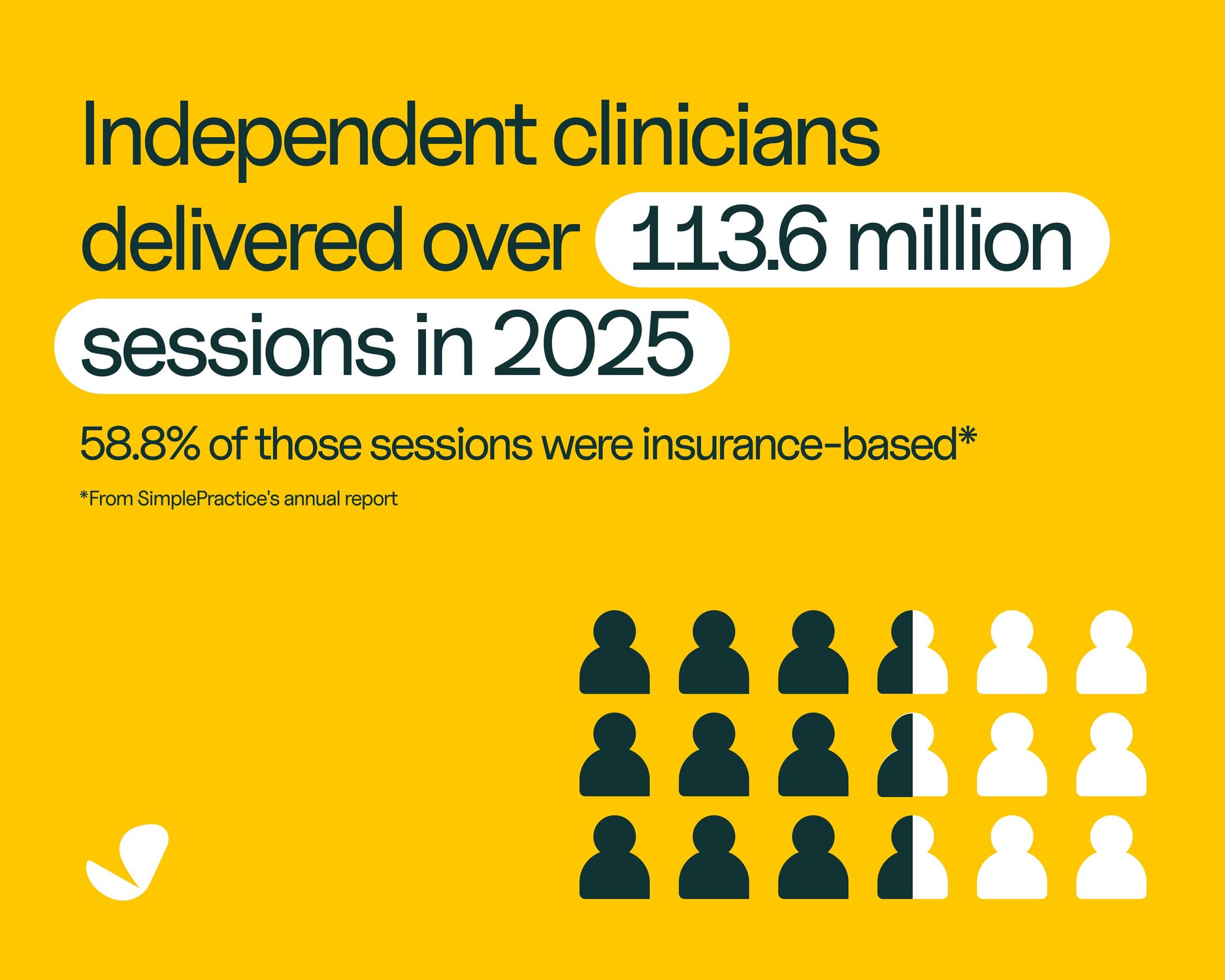
Despite this difference, independent practices remain a vital part of the healthcare system. Based on data analyzed from our platform, these practices facilitated 113.6 million sessions in 2025.
The data shows that insurance-based care is increasingly central to this reach, now accounting for 58.8% of all sessions—up from 55.8% in 2024.
This shift suggests that while financial sustainability requires careful rate management, clinicians are successfully leveraging hybrid models to maintain broad accessibility for insured patients without compromising the health of their practice.
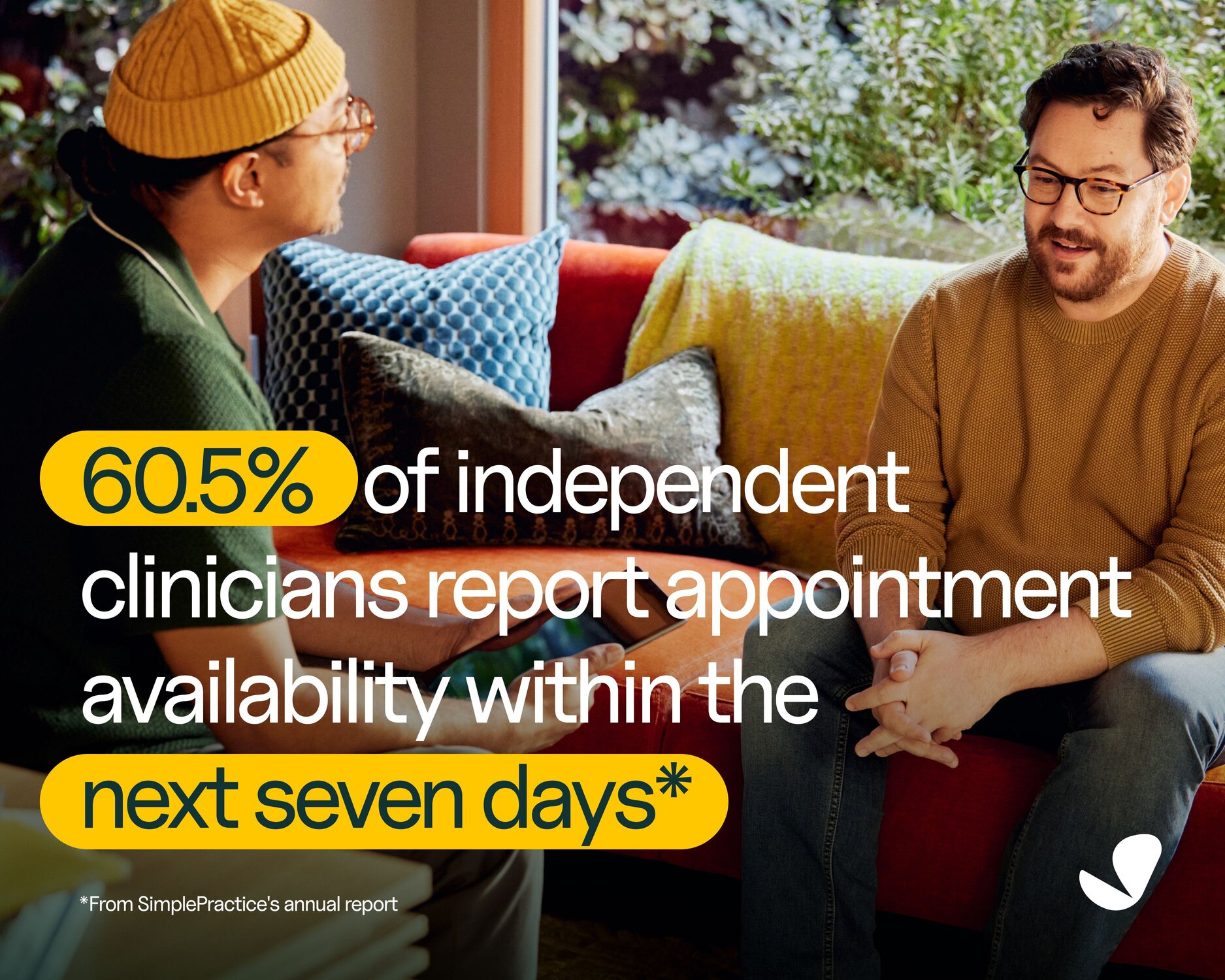
Beyond sheer volume, independent practice is distinguishing itself by how quickly patients can actually get in the door. Six in 10 independent clinicians—60.5%—report having appointment availability within the next seven days, underscoring the role of independent practices in keeping care accessible and timely.
That access extends into some of the country's most underserved communities. In 2025 alone, independent practitioners delivered 7.8 million sessions in rural regions, with telehealth serving as the primary bridge for access in areas where in-person care is scarce.
In those rural communities, 62% of clinicians report availability within seven days—a meaningful lifeline where mental health resources are limited.
While overall clinician satisfaction with independent practice is high—averaging 4.4 out of 5—and 87.9% of practitioners intend to stay in the field through 2026, the "administrative tax" of running a business remains a primary challenge.
The report identifies a critical training deficit: 43% of providers reported receiving zero hours of formal business training during their careers, despite being responsible for their own practice finances and operations.
This lack of training, combined with the heavy administrative burden of mental health insurance billing and documentation, is a leading driver of emotional fatigue.
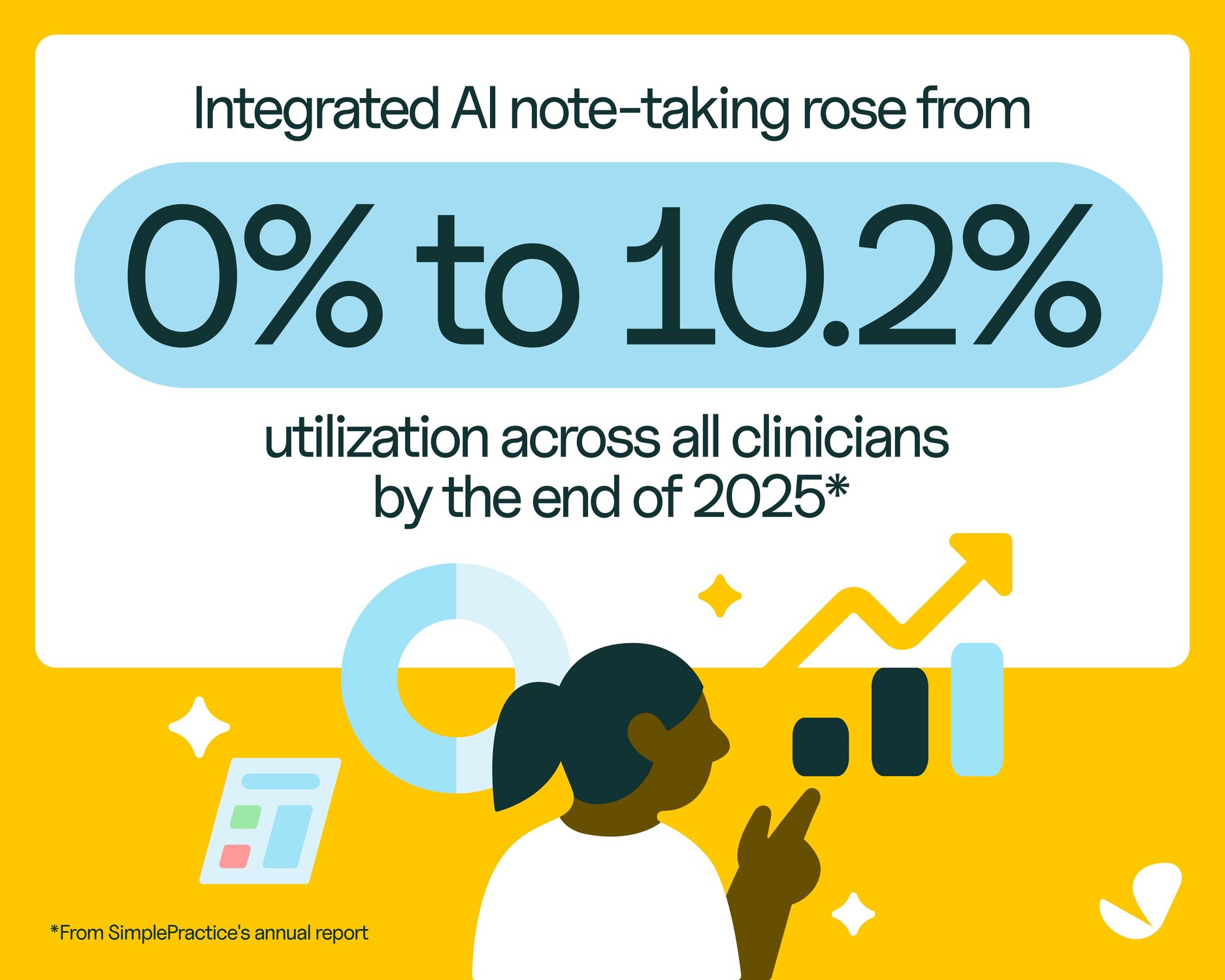
That burden is exactly what's driving rapid adoption of new tools. Integrated AI note-taking was brand new to the platform in 2025, yet it rose from no utilization at the start of the year to 10.2% across all clinicians by year-end—with early adopters saving an average of five hours per week on documentation, showing how much time AI can save.
Interestingly, the data shows that burnout levels vary by career stage, with practitioners licensed for 21+ years reporting slightly lower rates of burnout than those in the middle of their careers—suggesting that experience, and better systems, eventually mitigate stress.
The 2025 data confirms that the "hybrid" model is now the industry standard, but adoption varies by region.
Maryland (65.7%) and Washington D.C. (63.5%) lead the country in virtual care delivery, while South Dakota (23.3%) and Wyoming (24.7%) rank highest for in-person care nationwide.
Overall, in-person sessions hold a slight national majority at 52.5%, but geographic variation tells a more nuanced story. For rural communities especially, telehealth is less a preference and more a necessity—often the only viable option where resources are scarce.
The insights above are just a snapshot of the comprehensive data available in the full PDF regarding mental health insurance coverage and practice operations.
The complete "Annual State of Private Practice Report (2025 in Review)" provides a deep dive into the metrics that define our industry, including:
How do your state's private pay and insurance trends compare to the national average? Detailed tables for all 50 states provide a clear look at the difference between insurance and self-pay rates.
Which diagnostic specialties are driving the most volume—and is yours one of them? Insights into the 15 most common diagnostic categories and a breakdown of clinicians focusing on specialized populations.
How does your availability window compare to clinicians in your region? A granular look at how clinicians leverage telehealth to bridge access gaps in mental health "deserts."
Solo vs. group: who's growing faster heading into 2026? Comparison data including monthly cost-to-revenue ratios.
What does 17% projected industry growth mean for your practice? A closer look at clinician perspectives on interstate licensure compacts and workforce outlook.
Download the full "Annual State of Private Practice Report (2025 in Review)" to see where your mental health private practice stands and to gain the data you need to thrive in the coming year.
Authors and Primary Investigators
Lindsay Oberleitner, Ph.D., Head of Clinical Strategy
Jennifer Stidham, M.A., Clinical Strategy
SimplePractice is HIPAA-compliant practice management software with everything you need to run your practice built into the platform—from booking and scheduling to insurance and client billing.
If you’ve been considering switching to an EHR system, SimplePractice empowers you to run a fully paperless practice—so you get more time for the things that matter most to you.
Try SimplePractice free for 30 days. No credit card required.






Proudly made in Santa Monica, CA © 2026 SimplePractice, LLC
Proudly made in Santa Monica, CA © 2026
SimplePractice, LLC