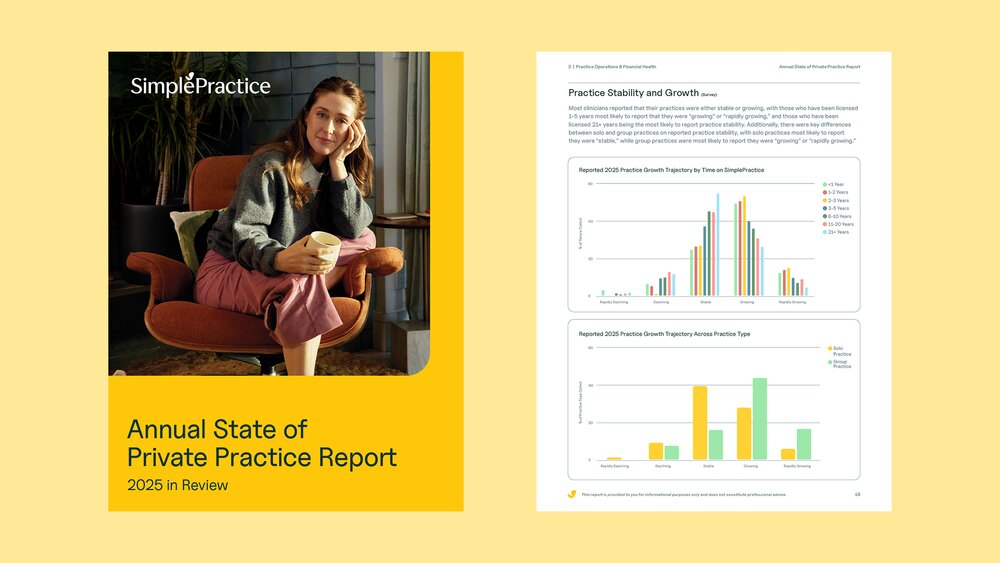
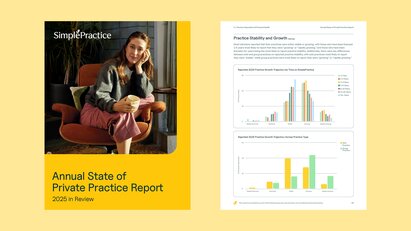
Annual state of private practice report (2025 in review)

Published October 5, 2026
Download the 2026 Clinician Well-Being Study
Download now
Download the 2026 Clinician Well-Being Study
Download nowThe 2026 Clinician Well-Being Study, a partnership between SimplePractice and Heard, examines the everyday realities of running an independent behavioral health practice—where pressure is building, what makes the work feel sustainable, and how practitioners are adapting.
Drawing from a survey of 862 independent behavioral health practitioners, the findings reveal a striking paradox: clinicians find deep meaning in their work, but the burden of running a practice is taking an escalating toll. Therapist burnout has climbed to 42% (up from 29% in 2023), driving 37% to reduce their caseloads.
The study breaks down the key wellness trends for 2026 in independent practice, including the financial, operational, and structural pressures behind rising therapist burnout and what they mean for therapist work-life balance. It also highlights the strategies practitioners are using to keep their practices viable.
Download the full 2026 Clinician Well-Being Study PDF for free to get the complete data.
For behavioral health professionals, launching an independent practice often represents the ultimate career milestone: clinical autonomy, deep personal meaning, and the freedom to deliver care on their own terms.
According to the 2026 Clinician Well-Being Study, that commitment to client care remains as strong as ever:
96% of clinicians report they can effectively meet their clients’ needs.
95% find profound personal fulfillment in their clinical work.
69% feel confident in the long-term sustainability of their practice.
Yet behind these reassuring numbers lies a growing operational burden. Clinical care can carry its own emotional weight, but rising burnout points to the financial, operational, and administrative demands of running a practice as a compounding strain.
When a clinician steps into private practice, they take on two distinct roles overnight: care provider and small business owner. While clinical training prepares clinicians for client care, few enter the field equipped to manage business infrastructure without organizational support.
The 2026 Clinician Well-Being Study identifies the biggest friction points currently challenging private practices across the country:
Independent care providers operate on thin margins where taking time off directly threatens their financial stability, which can make therapist work-life balance harder to protect.
Among clinicians experiencing burnout:
68% cite the inability to take sick leave or time off without financial penalty as a primary challenge.
37% spend six or more hours every week on non-clinical work.
Marketing and client acquisition for private practice is the most stressful responsibility clinicians report (48%), ahead of taxes (42%) and client documentation (38%). Marketing and client acquisition was also reported as getting worse over the past year for 31% of clinicians.
Economic uncertainty affects both sides of the therapeutic relationship. Nearly nine in ten clinicians (88%) say the rising cost of living is squeezing their personal finances, and 69% report that clients have reduced session frequency or paused care entirely due to cost.
While the operational demands are high, independent clinicians are not simply enduring the strain—they are actively using their autonomy to redesign how they work. The study highlights clear operational shifts among clinicians working to protect their capacity for care.
Therapists can automate much of the work surrounding care, including scheduling, billing, bookkeeping, and documentation, using tools like electronic health records (EHRs), billing services, and AI. Most independent practitioners already have this kind of software in place: 82% use an EHR or practice management platform, and 60% use bookkeeping or tax software. Bookkeeping for therapists is also an area where many bring in outside help, with 44% hiring a bookkeeper, accountant, or tax service.
Adopting the right tools can change how stressful the work feels. Before adopting an EHR or practice management platform, 47% of clinicians retrospectively described their stress managing their work as "high or extreme." Today, 11% do, and the same pattern shows up across every tool type in the study.
80% say their tools free up more time for client care and make it more sustainable to stay in the profession.
57% still spend too much time on tasks their current tools don't cover.
AI in therapy is already common: 65% of clinicians use AI in some capacity, most often for clinical documentation (47%), followed by marketing (20%) and administrative tasks like scheduling and billing (14%). Among clinicians who use AI, 87% see strong potential for it to reduce administrative burden.
Caution remains, though. Even among AI users, 73% worry about the accuracy of AI documentation and 71% worry it could devalue the human element of therapy, and those concerns are higher among clinicians who don't use AI.
Therapist work-life balance in private practice often depends on using the flexibility of independent practice to protect capacity for care. Dedicated self-care time is part of the routine for 72%, 55% have modified their work schedule, and 48% have reinforced stricter boundaries around working hours. Another 53% are in their own therapy or mental health care.
Running a business alone can be isolating, and 67% of clinicians say independent practice feels isolating when it comes to business or financial decisions. Still, 78% say a trusted peer network makes their practice feel more sustainable.
The full 2026 Clinician Well-Being Study is a 14-page report with charts, survey data, and takeaways across seven areas:
Fulfillment in private practice: How clinicians rate their effectiveness, practice sustainability, and burnout, including how burnout has changed since 2023.
Administrative challenges: The most stressful non-clinical tasks, the biggest sources of friction, and how many clinicians manage finances without support.
Sustainability via technology: How stress levels changed after clinicians adopted tools like EHRs, billing and scheduling software, bookkeeping software, AI tools, and virtual assistants.
AI adoption: How clinicians use AI and how attitudes differ between users and non-users.
The cost of care: How rising costs affect clinicians and their clients, including fee reductions and sliding scales.
Clinician self-care: How therapist work-life balance shows up in the schedule changes, boundaries, and support strategies clinicians use to protect their capacity for care.
Communities and support: Where peer and professional support gaps are largest.
Claim your free copy of the 2026 Clinician Well-Being Study. Get the full study to see the charts and survey data behind these findings.
SimplePractice is HIPAA-compliant practice management software with everything you need to run your practice built into the platform—from booking and scheduling to insurance and client billing.
If you’ve been considering switching to an EHR system, SimplePractice empowers you to run a fully paperless practice—so you get more time for the things that matter most to you.
Try SimplePractice free for 30 days. No credit card required.






Proudly made in Santa Monica, CA © 2026 SimplePractice, LLC
Proudly made in Santa Monica, CA © 2026
SimplePractice, LLC