ADHD sentence completion worksheet


Published October 15, 2026
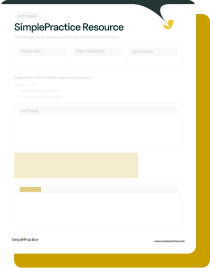
Download the exposure and response prevention worksheet
Download now
Download the exposure and response prevention worksheet
Download nowUse our free exposure and response prevention (ERP) worksheet to guide clients through ERP for obsessive-compulsive disorder (OCD).
This article explains how exposure and response prevention works and how to use the ERP worksheet in session or between sessions. You can also save the downloadable worksheet to your electronic health record (EHR) and use it in your practice.
Exposure and response prevention is an evidence-based treatment for OCD. Therapists also use it for other conditions where fear, avoidance, or rituals play a role, including body dysmorphic disorder, illness anxiety disorder, and social anxiety disorder. The evidence is strongest for OCD, so clinicians tailor the approach to each client’s diagnosis and symptoms.
Obsessive-compulsive disorder is a mental health condition characterized by obsessive thoughts and compulsive behaviors, which may include:
Obsessions: Recurrent unwanted and intrusive thoughts, such as contamination, dirt, illness, or fear of neglecting an important task, like forgetting to turn off the oven.
Compulsions: Rituals performed to neutralize the anxiety caused by the obsessive thoughts, such as counting, repetitive cleaning, washing, ordering, and repeating tasks.
OCD can cause significant distress and impair day-to-day functioning, and ERP is a first-line treatment for the condition.
With roots in cognitive behavioral therapy (CBT), ERP includes psychoeducation, exposure therapy, and helping clients resist compulsions. The goal of ERP is to challenge how people with OCD respond to distress and support them in learning that they can tolerate distress without compulsions and that feared outcomes are unlikely.
ERP works by gradually confronting fears, thoughts, objects, images, or situations while resisting the urge to engage in compulsive behaviors or rituals. This breaks the link between obsessions and compulsions. Like other types of exposure therapy, ERP involves gradual exposure under the guidance of a trained mental health professional.
The core steps of ERP include:
Identify obsessions and compulsions.
Create a fear hierarchy, ranking fears in order of severity.
Agree on a target sequence and approach to exposure, often starting with lower-level fears and gradually confronting each one. Exposures may involve real-life situations (in vivo), imagined situations (imaginal exposure), or physical sensations associated with anxiety (interoceptive exposure).
Guide the client in gradually facing their fears in a therapeutic setting.
Support the client in resisting the urge to engage in a compulsion.
Through repeated practice, clients learn that when they stay in the exposure exercise, their distress often decreases over time without compulsions. Each time they face a fear, the link between obsessions and compulsions can weaken, and more challenging fears may feel easier to tackle.
An example ERP exercise includes:
Obsessive thought: “If I touch doorknobs, I’ll get sick.”
Compulsion: Repeated handwashing and sanitizing multiple times a day.
ERP exercise: Touching a doorknob and not washing your hands for an hour.
This example is included in our downloadable exposure and response prevention worksheet to help clients identify their own obsessions and compulsions.
You can download and use the exposure response prevention worksheet in several ways:
Use the ERP worksheet to provide psychoeducation about OCD and treatment.
Complete the worksheet collaboratively in session and give the client a copy to take home.
Ask the client to reflect on the exposure and response prevention worksheet, complete the reflection questions between sessions, and report their findings at their next therapy appointment.
Use the ERP therapy worksheets in group therapy sessions to encourage clients to share more about themselves and how OCD affects their lives with other participants.
Adapt the ERP worksheet for clients with related conditions, such as body dysmorphic disorder or illness anxiety disorder, by replacing the OCD-specific examples with the client’s own fears and rituals.
Combine this worksheet with other anxiety and cognitive-behavioral therapy worksheets, including our introduction to anxiety worksheet, cognitive distortions worksheet, and CBT thought record.
Share the worksheet with coworkers or leave copies in your office.
Use the ERP for OCD worksheets to provide training to interns or supervisees on OCD treatments.
American Psychological Association. (n.d.). Obsessive-compulsive disorder.
Anxiety and Depression Association of America. (2021). Exposure and response prevention for “what if” thinking in disorders other than OCD.
Hezel, D. M., & Simpson, H. B. (2019). Exposure and response prevention for obsessive-compulsive disorder: A review and new directions. Indian Journal of Psychiatry.
International OCD Foundation. (n.d.). Exposure and response prevention (ERP).
Law, C., & Boisseau, C. L. (2019). Exposure and response prevention in the treatment of obsessive-compulsive disorder: Current perspectives. Psychology Research and Behavior Management.
SimplePractice is HIPAA-compliant practice management software with everything you need to run your practice built into the platform—from booking and scheduling to insurance and client billing.
If you’ve been considering switching to an EHR system, SimplePractice empowers you to run a fully paperless practice—so you get more time for the things that matter most to you.
Try SimplePractice free for 30 days. No credit card required.






Proudly made in Santa Monica, CA © 2026 SimplePractice, LLC
Proudly made in Santa Monica, CA © 2026
SimplePractice, LLC